Most businesses run Google Ads. Very few have a system.
There is a big difference between the two.
Running ads means you set a budget, write something, and hope people call. A system means every step from the moment someone searches to the moment they contact you is thought through and working together.
If your Google Ads lead generation system is not built properly, it does not matter how much you spend. The results will always be inconsistent.
This post breaks down exactly what that system looks like and how to build it.
Quick question before we start:
Which part of Google Ads do you struggle with the most?
A) Getting the right people to click my ads
B) Converting clicks into actual enquiries
C) Understanding what is working and what is not
D) All of the above(Drop your answer in the comments)
What Is a Google Ads Lead Generation System
A lead generation system is not just an ad.
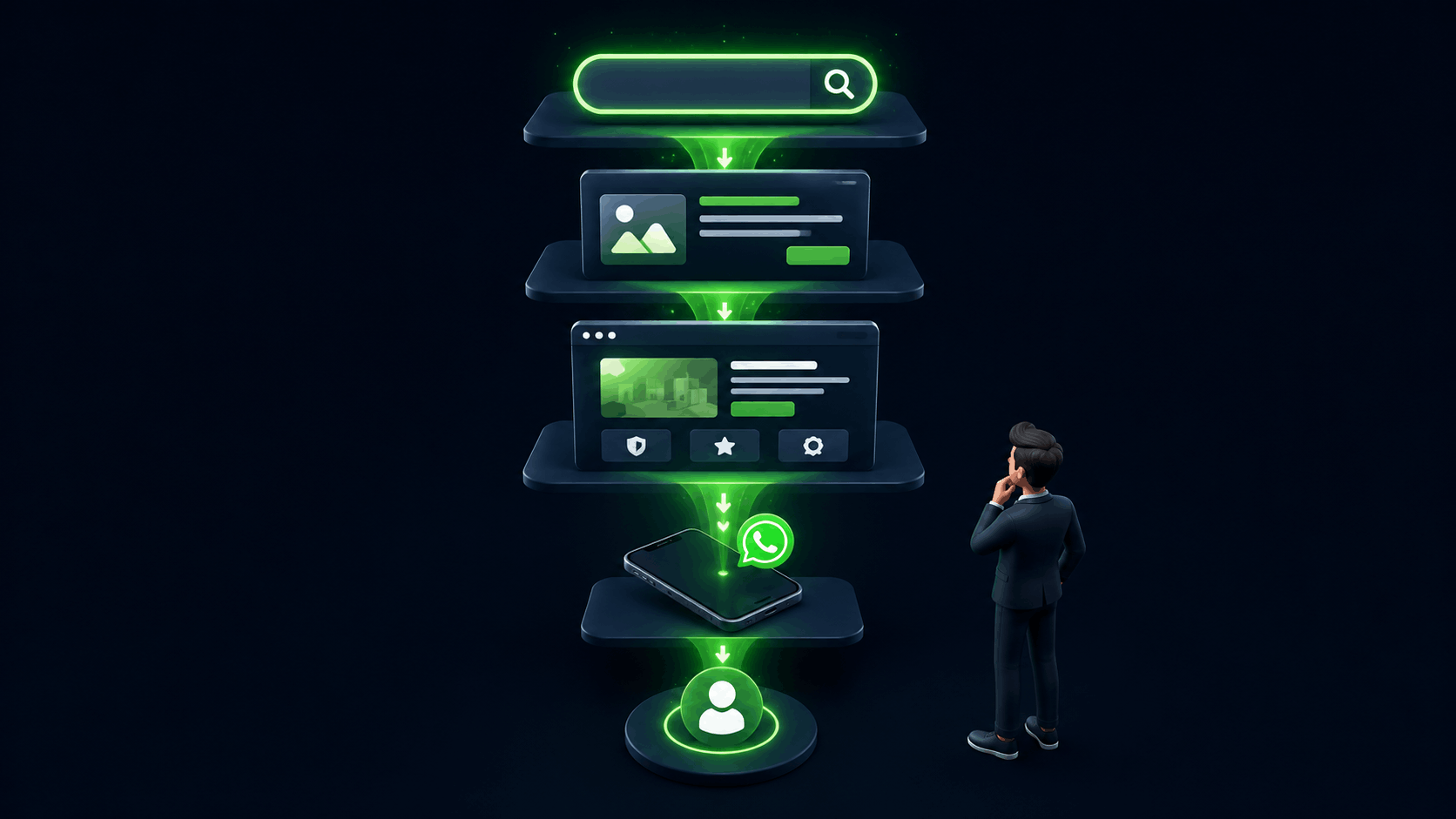
It is the full journey a potential customer takes from the moment they type something into Google to the moment they send you a message or pick up the phone and call.
Every step in that journey either moves them closer to contacting you or pushes them away.
Most businesses only focus on the ad itself. But the ad is just the entry point. What happens after the click is where leads are won or lost.
A proper Google Ads lead generation system has four parts. Each one depends on the others. If one part is weak, the whole system breaks down.
The 4 Parts of a High Converting Google Ads Lead Generation System
1. The Right Ad
Everything starts here.
Your ad needs to show up in front of the right person at the right moment. That means targeting keywords that show buying intent, not just interest.
Someone searching “interior design inspiration” is browsing. Someone searching “interior designer in Pune” is ready to hire. These two people are completely different and your ad should only be targeting the second one.
Beyond the keyword, your ad copy matters too. Your headline needs to speak directly to what the person is looking for. If someone searches “home renovation contractor in Bangalore,” your ad should say something about home renovation in Bangalore, not a generic message about your services.
A good ad does three things:
- It matches what the person searched for
- It gives them a reason to click over your competitor
- It sets the right expectation for what they will find on the next page
2. The Right Landing Page
This is where most businesses lose their leads.
A landing page is not your homepage. Your homepage talks about everything your business does. A landing page has one job: to turn the visitor into an enquiry.
When someone clicks your ad, they have a specific need in their mind. Your landing page needs to speak directly to that need within the first few seconds. If they have to scroll, read through paragraphs, or figure out what you do, they will leave.
A high converting landing page has:
- A clear headline that matches the ad they clicked
- A simple explanation of what you offer and who it is for
- A few trust signals like past work, client results, or years of experience
- One clear call to action, a phone number, a WhatsApp button, or a short form
- No distractions, no unnecessary links, no reason to leave without contacting you
The goal of the landing page is not to impress. It is to make it easy for the right person to take the next step.
3. The Right Follow Up
This part is almost never talked about, but it matters more than most people realise.
Speed kills or converts.
When someone fills out a form or sends a WhatsApp message, they are in the moment. They are ready to talk. If you respond within 5 minutes, your chances of converting that lead into a client are significantly higher than if you respond 5 hours later.
By the time you call back the next morning, they have already spoken to two other businesses.
A good follow up system looks like this:
- Instant acknowledgement, either an automatic WhatsApp reply or a confirmation message
- A personal call or message within 5 to 15 minutes during business hours
- A follow up the next day if they did not respond
- A final follow up 3 days later
Most leads do not convert on the first contact. The businesses that follow up consistently are the ones that win.
4. Tracking and Optimising
This is what separates a system from a guess.
Without tracking, you do not know which keyword brought in a lead. You do not know which ad is performing better. You do not know which landing page version gets more form submissions.
Conversion tracking is the foundation of a Google Ads lead generation system that improves over time. You set it up once and it starts feeding data back into your campaigns so Google knows what a successful outcome looks like for your business.
Once tracking is in place, you start looking at:
- Which keywords are generating actual enquiries, not just clicks
- Which ads are getting clicks but not converting
- What time of day and day of week your best leads come in
- How much each lead is actually costing you
With this data, every decision you make going forward is based on what is actually working. You stop spending on what is not and put more behind what is.
How It All Works Together
Here is the thing about a system. Every part depends on the others.
You can have the perfect ad but if the landing page does not match it, people leave. You can have a great landing page but if you are targeting the wrong keywords, the wrong people are landing on it. And you can get good leads but if your follow up is slow, you lose them before they become clients. And if you have no tracking, you will never know which part is working and which part needs fixing.
This is why businesses that “just run ads” rarely get consistent results. They fix one part without realising the other parts are broken.
A Google Ads lead generation system that actually works treats all four parts as one connected process. When all four are working together, you get a predictable, repeatable flow of enquiries from your ads.
So Where Do You Start
Start with an honest look at each of the four parts.
Are your keywords targeted at people who are ready to hire? Does your landing page speak directly to what your ad promises? Do you have a follow up process that responds fast? Do you have conversion tracking in place?
If even one of these is missing or weak, that is where your leads are going.
Building a proper Google Ads lead generation system takes time to set up correctly. But once it is running, it works for you every single day.
If you want to know exactly where your current setup is falling short, we offer a free audit. No cost, no obligation. We go through your campaign and tell you what needs fixing.
Related Posts
Frequently Asked Questions (FAQs)
It is the full process from your ad to the enquiry. It includes your keywords, your landing page, your follow up process, and your conversion tracking all working together.
It depends on your industry and location. But more important than budget is setup. A well built system on a small budget will always outperform a poorly built system on a large budget.
A properly set up campaign can start generating enquiries within 2 to 4 weeks. The first month is mostly about collecting data and making early optimisations.
A dedicated landing page almost always performs better than sending traffic to your homepage. Your homepage has too many options. A landing page has one goal.
All four parts matter, but conversion tracking is the one most businesses skip. Without it, you cannot improve what you cannot measure.